This site contains affiliate links. We may earn a commission if you purchase through our links at no extra cost to you. All opinions are our own. Learn more.
Walk into any performance clutch website and you’ll see them: Stage 1, Stage 2, Stage 3, Stage 4. The terms are everywhere — but what do they actually mean? Is a Stage 2 clutch automatically better than a Stage 1? Do you need one if you’ve added an intake and a tune? Will it destroy your daily commute?
This article answers all of it clearly. We’ll explain what each clutch stage actually means in terms of components, torque capacity, pedal feel, and real-world use. We’ll tell you exactly when a Stage 2 upgrade is worth it — and when it’s overkill. We’ll cover the major manufacturers that define the stage system (ACT, SPEC, South Bend, Clutch Masters), give you real pricing, and end with a concrete decision guide so you know exactly which stage your car needs.
Organic vs Ceramic vs Kevlar Clutch Plates — Which Material Is Right for Your Car?
First — Where Do Clutch Stages Come From?
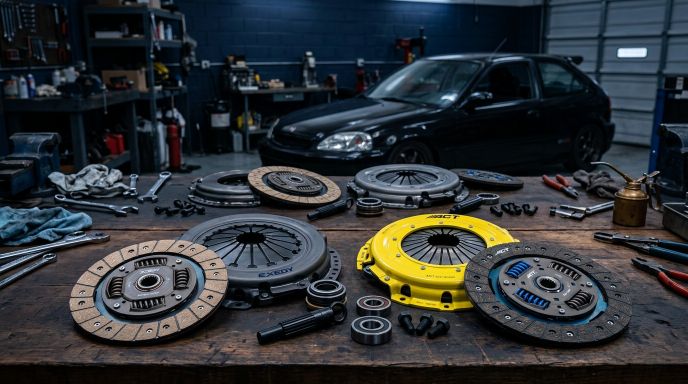
The “stage” system isn’t a universal standard set by an industry body — it was developed by performance clutch manufacturers like ACT (Advanced Clutch Technology), SPEC Clutch, South Bend Clutch, and Clutch Masters as a way to categorise their product lines by torque capacity and intended use. Each manufacturer has their own stage definitions, though there’s general agreement on the core concept: higher stages = higher torque capacity and firmer engagement.
Stage 1 is universally understood as an OEM-quality replacement or mild upgrade — essentially matching what came from the factory. Stage 2 upgrades the pressure plate clamping force and disc friction material. Stage 3+ moves into track/competition territory. Stage 4 and 5 are typically race-only, with aggressive disc materials (puck-style ceramics) that aren’t suitable for daily driving. The challenge for buyers is that “Stage 2 from ACT” and “Stage 2 from South Bend” are not identical — they may have different torque capacities, disc materials, and engagement characteristics. Always compare the specific torque rating, not just the stage number.
Clutch Stage Breakdown — Stage 1 Through Stage 4+
| Stage | Pressure Plate | Disc Material | Torque Capacity | Pedal Feel | Best For |
|---|---|---|---|---|---|
| Stage 1 (OEM) | Stock/standard | Organic | Up to ~200-250 lb-ft | Light, stock feel | Stock engines, daily drivers |
| Stage 2 | Upgraded clamp (+15-30%) | Organic Sprung or Kevlar | 250-400 lb-ft | Slightly firmer than stock | Mildly modified: intake, exhaust, tune |
| Stage 3 | Heavy duty (+30-50%) | Ceramic or Kevlar | 350-600 lb-ft | Noticeably firmer | Heavily modified: big turbos, cams, supercharger |
| Stage 4 | Competition (+50-80%) | 4-puck or 6-puck ceramic | 500-900+ lb-ft | Heavy, aggressive on/off | Race cars, drag cars, occasional street |
| Stage 5/Twin | Race-only | Multi-disc ceramic | 800-1,500+ lb-ft | Very heavy, on/off | Pure race/competition, drag racing |
Stage 1 — OEM Replacement Quality
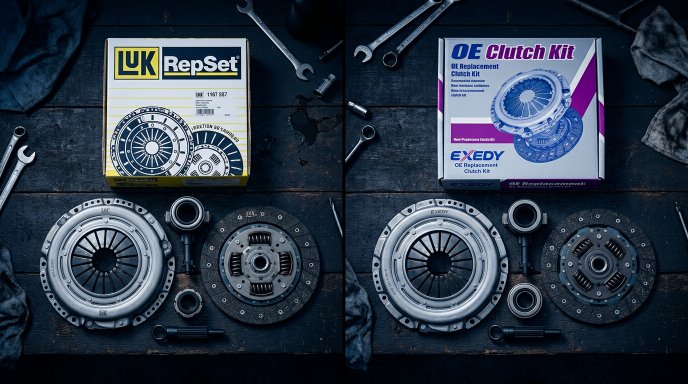
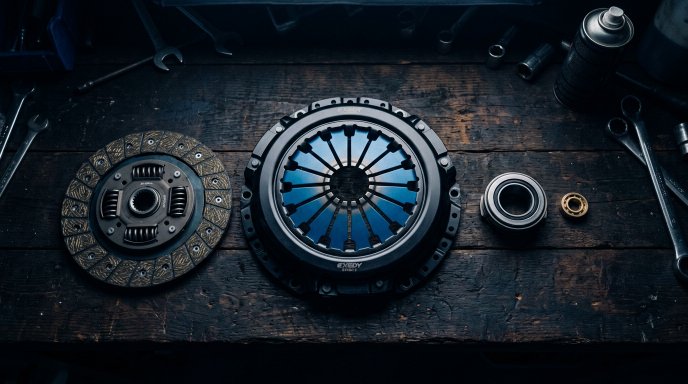
Stage 1 clutches are functionally equivalent to what came in the car from the factory. The friction disc uses organic material (smooth, quiet, streetable), the pressure plate delivers OEM-equivalent clamping force, and the engagement feel is identical to a new factory clutch. Stage 1 is the correct choice for any stock or mildly modified vehicle. There’s no reason to pay more for a Stage 2 if your engine is producing stock or near-stock torque. Examples: Exedy OEM-spec kits, LuK RepSet kits, Aisin OEM kits — all are effectively Stage 1. Torque capacity: typically up to 200-250 lb-ft at the wheels. Pedal feel: light, smooth, progressive.
Stage 2 — The Sweet Spot for Modified Street Cars
The Stage 2 clutch is where the majority of modified street cars land. It upgrades the pressure plate with increased clamping force (typically 15-30% above OEM), and upgrades the friction disc to either an organic sprung disc with a steel-backed design (for improved durability) or a Kevlar/hybrid material (for higher heat resistance and torque capacity). The result is a clutch that can handle the torque produced by a tuned engine — bolt-on modifications (cold-air intake, downpipe/exhaust, ECU tune) that push power output 15-30% above stock — while still maintaining streetable engagement.
According to SPEC Clutch, a Stage 2 disc uses Kevlar friction material which offers “higher torque capacity and longer wear life” compared to organic. The pedal will feel slightly heavier than OEM, but shouldn’t feel dramatically different in daily driving. Important: Stage 2 does NOT mean “better for daily drivers than Stage 1” — it means “appropriate for more power than Stage 1 can handle.” On a stock engine, Stage 1 is the correct choice, not Stage 2. Torque capacity: typically 250-400 lb-ft at the crank. Example pricing: ACT Heavy Duty Street Sprung kits typically run $350-$600 for popular platforms.
Stage 3 — For Heavily Modified Cars
Stage 3 is for vehicles that have gone significantly beyond bolt-on modifications. Big turbos, built engines, aggressive cam profiles, forced induction on naturally-aspirated platforms — these scenarios generate torque levels that destroy Stage 2 clutches over time. Stage 3 clutches use full ceramic or Kevlar friction discs, very stiff diaphragm springs in the pressure plate, and sometimes a lighter (single-mass) flywheel to reduce rotational inertia. The engagement is significantly more aggressive than stock — the on/off transition is faster and more definitive.
Not ideal for stop-and-go city traffic; fine for a car that gets driven mostly on backroads and track days. Torque capacity: typically 350-600 lb-ft at the crank. Example: ACT Extreme Performance clutches for STI/WRX platforms are rated at 449-574 lb-ft depending on disc material.
Do You Actually Need a Stage 2 Clutch? — Decision Guide
| Your Situation | Stage Recommendation |
|---|---|
| Stock engine, normal driving | Stage 1 (OEM replacement) |
| Stock engine + CAI + tune (under +20% torque) | Stage 1 is still fine, Stage 2 is optional insurance |
| Turbocharged, +20-40% torque over stock | Stage 2 |
| Big turbo, built engine, +50%+ torque | Stage 3 |
| Drag racing, track-only car | Stage 4 / Stage 5 / Twin Disc |
| Daily driver with occasional track days | Stage 2 (if modified) or Stage 1 (if stock) |
| Diesel truck with heavy towing | Stage 2 or Dual Friction (Centerforce) |
One of the most common mistakes is buying a Stage 3 or Stage 4 clutch for a mildly modified daily driver, believing “more stage = more better.” A Stage 3 on a stock Honda Civic Si will have a harsher pedal, noisier operation, faster disc glazing at low power outputs, and a shorter service life on a stock engine than a Stage 1 OEM kit. Match the stage to your actual power level — not to your aspirations.
Stage 2 Clutch Products — Real Examples & Prices
SPEC Clutch Stage 2 — Honda Civic Si / WRX
The SPEC Stage 2 uses a Kevlar-lined friction disc with steel backing, delivering higher torque capacity (typically 280-350 lb-ft) compared to an OEM organic disc. SPEC's Stage 2 is widely recommended for Civic Si owners with tune and bolt-ons or WRX owners running a stage 1 tune.
ACT Heavy Duty Street Sprung (HD/SS)
ACT's Heavy Duty Street Sprung kit is functionally equivalent to a Stage 2 — it upgrades the clamping force (~39% over OE per ACT's specification) while keeping the sprung organic disc for smooth street engagement. Torque capacity: 449 lb-ft at the crank. Ideal for 15-21 WRX with a Cobb Stage 1/2 tune.
South Bend Clutch Stage 2 Daily
South Bend's Stage 2 Daily kits are designed specifically for street-driven modified vehicles — they balance the increased clamping force of a stage upgrade with a disc designed for smooth, low-noise daily engagement. Available for Ford Mustang GT/Shelby, Camaro SS, and various GM platforms. Excellent choice for muscle-car owners who track on weekends and commute on weekdays.
Clutch Masters FX250 Stage 2
Clutch Masters' FX250 is their Stage 2 equivalent, using a 6-puck organic/Kevlar composite disc with an upgraded pressure plate. It's one of the most widely available Stage 2 options across multiple platforms (BMW, Honda, Subaru, Ford, Volkswagen).
Stage 2 Clutch — What to Expect After Installation
- Pedal Feel Change: Expect a 10-25% heavier pedal compared to OEM. This is normal for a Stage 2 and is the result of the increased diaphragm spring clamping force. Most drivers adapt quickly — usually within a few days of daily driving.
- Break-In Period: Stage 2 clutches require the same 500-mile break-in procedure as OEM clutches, but with more attention to avoiding hard launches in the first 200 miles. Kevlar disc material needs heat-cycling to bed properly against the flywheel.
- Engagement Point May Shift: Many Stage 2 clutches have a slightly different engagement point (bite point) compared to the OEM clutch. This is normal — you’ll re-learn the bite point within a day or two of driving.
FAQ — Stage 2 Clutch
Q1: Will a Stage 2 clutch make my car faster?
No — a clutch doesn’t add power. A Stage 2 clutch enables your engine’s existing power to be transferred to the transmission without slipping. If your OEM clutch isn’t slipping, a Stage 2 upgrade won’t change your performance. If your OEM clutch IS slipping due to power output, a Stage 2 will restore full power transfer.
Q2: Is a Stage 2 clutch good for daily driving?
Yes, with caveats. Stage 2 clutches are designed to be streetable and are used daily by thousands of modified car owners. The pedal is heavier than OEM, engagement is slightly more abrupt, and low-speed manoeuvring can feel different. For stop-and-go urban commuting, a well-chosen Stage 2 (organic disc, street-sprung hub) is perfectly liveable.
Q3: How much power can a Stage 2 clutch handle?
Depends on the specific kit and manufacturer, but generally 250-400 lb-ft of torque at the crank for most Stage 2 kits. ACT’s HD/SS line is rated for 449 lb-ft for WRX applications. SPEC Stage 2 typically handles up to 350-400 lb-ft. Always check the specific torque rating for your model — “Stage 2” is not a universal specification.
Q4: What is the difference between Stage 1 and Stage 2 clutch?
Stage 1 is OEM-equivalent (or very close to OEM) — organic disc, standard clamping force, light pedal. Stage 2 upgrades the pressure plate clamping force (15-30% above OEM) and often upgrades the disc to Kevlar or a steel-backed organic design. Stage 2 handles more torque but has a slightly heavier pedal. Stage 1 is for stock engines; Stage 2 is for modified engines.
Q5: Do I need a new flywheel with a Stage 2 clutch?
Not always, but it’s strongly recommended if the existing flywheel has scored surfaces, hot spots, or is due for replacement. Many Stage 2 kits from ACT and SPEC are available with or without a flywheel. Using a Stage 2 disc against a worn flywheel will shorten the clutch’s lifespan significantly. If the flywheel is in good condition (resurface-able), you can save money. If it’s near the end of its life, budget for a replacement.
Our Verdict — What Stage Do You Actually Need?
For the vast majority of enthusiast car owners — modified or not — Stage 2 is the practical ceiling for street driving. It handles everything from lightly tuned compacts to genuinely boosted builds, while keeping the car liveable for daily commuting. Stage 1 is correct for stock engines. Stage 3 is for seriously modified track cars with sustained high-power use. Stage 4+ is competition-only.
The most important thing: match the stage to your specific torque output. Check the manufacturer’s torque capacity for the specific clutch on your specific vehicle — not just the stage number. A correctly-matched Stage 2 will outlast an under-spec’d Stage 1 on a modified car, every time.